
The Suzuki Philosophy
Shinichi Suzuki
Suzuki had a profound interest in child development, which led him to a groundbreaking realization: children from any culture can naturally and effortlessly learn their native language, regardless of intelligence. He observed that by the age of five, they could easily master over 4,000 words through repetition and supportive environments. This insight inspired his belief that any child could achieve a high level of ability in any field if the environment was conducive to learning, just as it is for language acquisition. He termed this concept “The Mother Tongue Method,” which became the cornerstone of his educational philosophy.
Born in Nagoya, Japan, in 1898, Suzuki grew up in a musical household, influenced by his father’s work as a violinmaker. After studying the violin for several years in Japan, he traveled to Berlin in the 1920s to study under Karl Klingler, a pupil of the celebrated violinist Joseph Joachim. Upon returning to Japan, he formed the Suzuki Quartet with his brothers and took on leadership roles at the Teikoku Music School and the Tokyo String Orchestra, promoting Western classical music, including Baroque works, to Japanese audiences.
In the later years of World War II, Suzuki moved to Matsumoto, where he founded the Yoji Kyoiku Doshikai (Group for Child Education). With support from the head of Hongo Primary School, he implemented his educational philosophy across various subjects, including Japanese, Chinese, calligraphy, drawing, English, and gymnastics. These experimental classes achieved remarkable success, leading him to establish the Saino Kyoiku Kinkyu-kai in 1950, where he began applying his method to violin instruction. His approach, known as “Talent Education,” gained rapid popularity, resulting in 2,321 students graduating from his school by 1972.
Suzuki’s philosophy emphasized that “every child can learn,” advocating for accessible music education for all children, not just those deemed “talented.” His method spread beyond the violin, encompassing instruments such as viola, cello, bass, guitar, harp, piano, flute, oboe, recorder, as well as vocal training and early childhood education. He also wrote several books on music education and child development, further disseminating his ideas.
Even after his passing in 1998, Shinichi Suzuki’s legacy continues to thrive. Today, his method is practiced in studios, schools, and institutes worldwide, inspiring a love of music and learning in students of all ages.
The Suzuki Philosophy
Dr. Suzuki believed that every child can learn, a statement that opens the world of music to everyone, not just those labeled as talented. According to Suzuki, “Musical ability is not an inborn talent but an ability which can be developed. Any child who is properly trained can develop musical ability, just as all children develop the ability to speak their mother tongue. The potential of every child is unlimited.”
He famously said, “Teaching music is not my main purpose. I want to make good citizens, noble human beings. If a child hears fine music from the day of his birth and learns to play it himself, he develops sensitivity, discipline, and endurance. He gets a beautiful heart.”
Where love is deep, much will be accomplished. – Shinichi Suzuki
The Suzuki Method
Parent Involvement
In the Suzuki method, parent involvement is paramount. Often referred to as the “home teacher,” the parent attends lessons with the child and practices with them at home. Many parents may even take lessons themselves to create a musical environment and to assist the child more effectively.
Early Learning
Suzuki instrumental instruction can begin as early as age three, an optimal time for children developmentally. Suzuki Early Childhood Education family classes can begin as early as birth and continue to age 4. Even before this age, parents can create a musical environment at home by playing music. Babies are listening to sounds in their environment even before birth! The Suzuki environment is nurturing, allowing children to progress at their own pace. Skills are introduced in small steps, ensuring thorough mastery and fostering confidence.
Group Classes and Positive Reinforcement
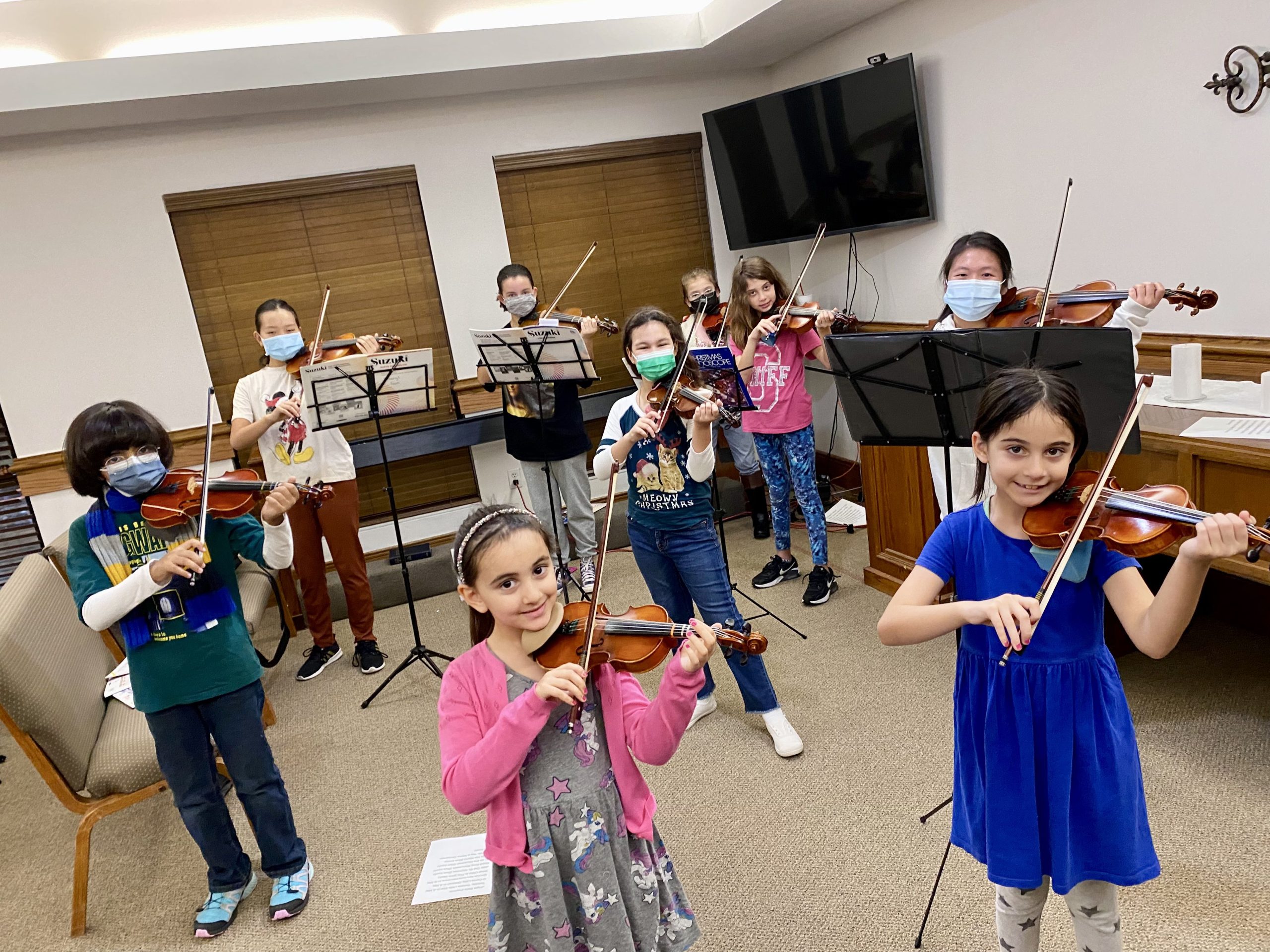
Suzuki education includes both private lessons and group classes. Positive peer interaction in these group settings helps motivate children, while advanced students serve as role models. Parents, teachers, and students support each other in a non-competitive environment, promoting growth and encouragement.
Learning by Ear
A key aspect of the Suzuki method is that children learn to play music by ear before learning to read music. Suzuki teachers emphasize listening to recordings of current pieces multiple times a day, helping children “speak” music naturally. Memorization of the repertoire is integral, with repetition being a core component of learning.
Building Repertoire through Review
Mastery in the Suzuki method is achieved through continual review of previously learned pieces. Just as children continuously use vocabulary words they’ve learned, Suzuki students revisit and refine their repertoire, which serves as a foundation for learning new skills.
Suzuki Repertoire
The Suzuki repertoire consists of carefully chosen works, beginning with folk songs and familiar melodies before progressing to pieces by the great masters of classical music. These pieces are designed to teach musical and technical skills, fostering enjoyment and growth.
Note Reading
In the Suzuki method, note reading is introduced after the child has developed basic instrumental skills. This ensures that early instruction focuses on essential elements like tone, posture, intonation, and musical expression. Reading music is integrated gradually, once the child is ready.